
- For other uses of this term, see Royal (Disambiguation).
A royal is a member of a monarchic family ruling over a country, typically referred to as a kingdom (王国, ōkoku?). The majority of countries in the Blue Planet with known governments are ruled over by royalty, and royal bloodlines have played a big role in the history of the World Government, which hosts a representative council of affiliated royals known as the Levely.
Overview[]
Individual monarchies exist all across the world, and there is no universal set of customs binding them. However, they do possess many common practices and standards. Multiple races possess monarchic nations.
In a typical monarchy, the power is held by a single bloodline, referred to as a royal family (王家, ōke?) or dynasty (朝, asa?); a person's right to become the monarch stems from their possession of royal ancestry. All accepted members of the royal family possess influence over their kingdom, but it is the monarch who is its highest authority, and the monarch is regarded as the head of the royal family (usually its patriarch). A monarch's power is commonly symbolized by their sitting on a throne, where they hold audiences with subjects and issue decrees. There is an order of succession among the family for when the current monarch's reign ends. Unless they willingly cede power or are coerced into it, a monarch remains on the throne until death.
It is generally understood that the monarch holds near-absolute authority over their kingdom and subjects, having no other forms of regional government that limit their power. To maintain their rule, they must simply take measures to maintain their institutions and prevent any potential armed uprising from the populace. Monarchs can typically shape the culture and objectives of their dominion according to their whims. They may operate with impunity regarding local law and disregard it altogether, but some are more tightly bound to established customs, such as on Elbaph, where King Harald was prohibited from marrying an outsider by the kingdom elders.
No monarchy is exactly equal to another one in terms of power and influence, as these come mainly from a country's wealth and resources, so naturally some royals possess tangible advantages compared to others. The Levely officially gives each of its participants an equal voice, but the established disparities between nations still influence its proceedings.[2] Additionally, the format of the Levely creates disparities in itself, as only 50 of the 170 World Government nations are represented, and the government has been shown accepting bribes to allow a country a seat at the council.[3]
Titles[]
King[]
- For other uses, see King (Disambiguation).
Kings (王, Ō?) are male monarchs. In a traditional monarchy, the king is the patriarch and leader of the royal family, holding the most political power.
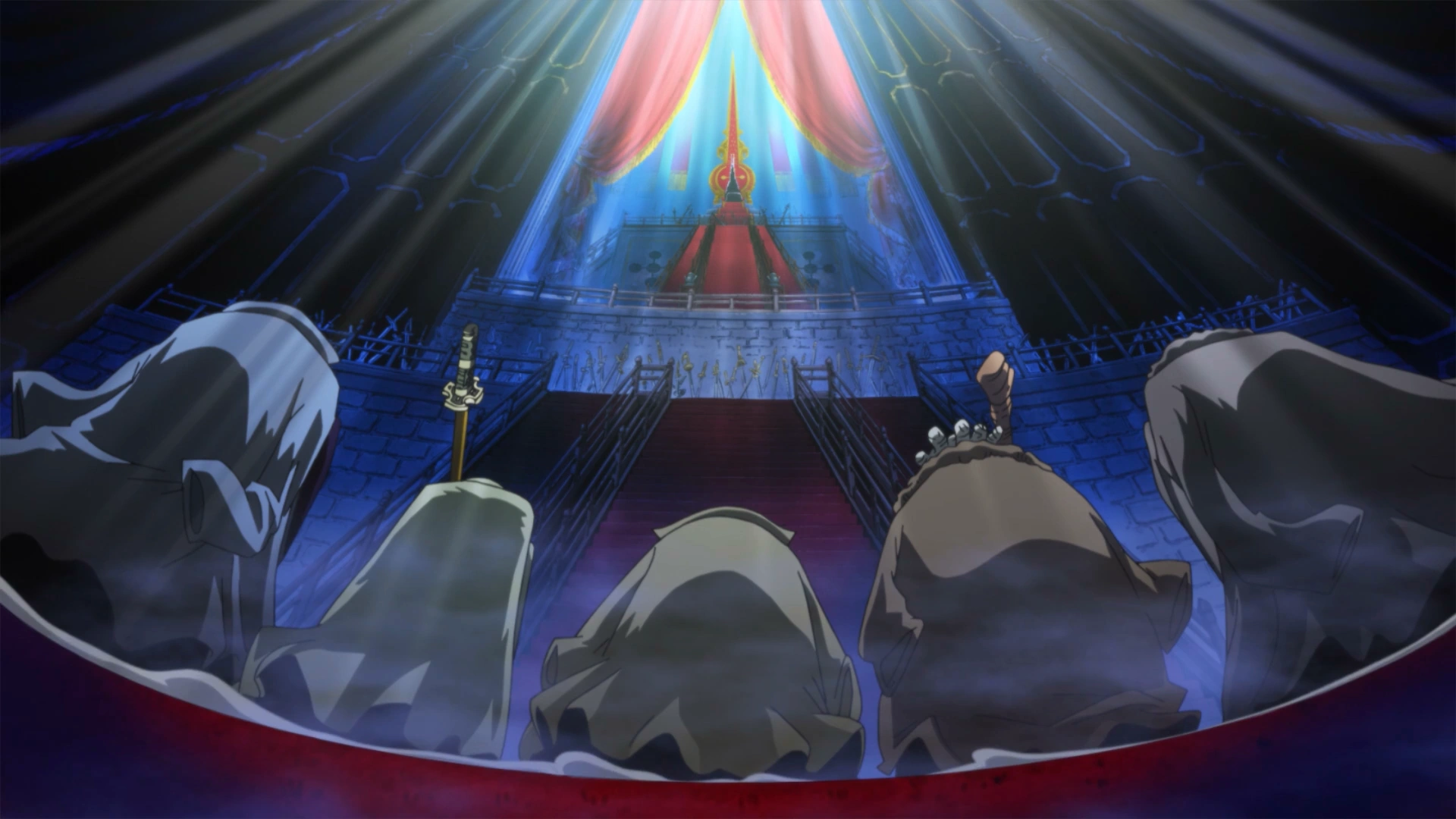
Imu sitting on the Empty Throne, with the Five Elders bowing to him.
It is public knowledge that no singular King of the World (世界の王, Sekai no Ō?) exists, a fact signified by the Empty Throne in the Holy Land Mary Geoise ostensibly having no occupant, which is meant to symbolize that the rulers of all the assorted nations on the Blue Planet are no greater or lesser than each other.[4] In reality, the Empty Throne does have a current holder: Nerona Imu, the enigmatic shadow ruler of the World Government and thus the sole figure to rule over the entire world.[5][6] Despite the secrecy surrounding Imu's existence and occupancy of the Empty Throne, there have been non-Celestial Dragons aware of the connotations of being King of the World, and it was specifically the pirate Rocks D. Xebec who sought to claim the title,[7] believing that his ancestor Davy D. Jones was King of the World in the distant past.[8]
The title of King is frequently used in epithets, even outside a royal context. In such cases, it typically denotes someone who is especially distinguished in their field. For example, the popular term "Pirate King" was granted to Gol D. Roger because he had amassed more wealth, fame, and power than any other pirate.[9][10] While not an official title, the King of All Giants (全巨人族の王, Zen Kyojin-zoku no Ō?, VIZ: "King of the Giants") is said to unite all the giant tribes of the world.[11]
Queen[]
- For other uses, see Queen (Disambiguation).
Queens are female monarchs. A queen regnant (女王, joō?) possesses the highest authority over her country akin to a king; no traditional queen regnants have been seen with husbands. When married, queens have always been called consorts (王妃, ōhi?) who rule alongside their husbands as the matriarch of the royal family, though the king appears to hold primary political power. A widowed queen is called a dowager (王太后, ōtaigo?) and does not maintain the throne, but rather lives in the care of the royal family while their next of kin assumes the throne.
Prince and Princess[]
Princes (王子, Ōji?) and Princesses (王女, Ōjo?) are respectively the male and female descendants of monarchs. They are typically heirs to their parents, preparing to succeed to the throne once their parent leaves power. Though typically living in luxury, princes and princesses may be called upon to serve their kingdom's populace under the direction of their parents, with princes more commonly being involved in guard or military service.
One may not be recognized with this title if one of their parents is not accepted as part of the royal family, which occurred with Hajrudin, who is considered an illegitimate son of King Harald due to his mother Ida not being Harald's wife.[12] Princes and princesses can also lose the title if they are disowned by their parents.
Other Titles[]
Some countries have forms of government which resemble monarchies, but do not necessarily follow the same customs or use the same monarchic titles.
- Skypiea is ruled unilaterally by one person with the title of God, but the title is not meant to deify them. It is not known how succession to the title works, other than in instances of the previous God being deposed.
- The Kuja on Amazon Lily are ruled by an empress (皇帝, kōtei?). Each empress is appointed by her predecessor, with strength being a factor in selection.
- The Mokomo Dukedom is ruled over by a duke (公爵, kōshaku?) who possesses authority equivalent to a monarch. However, a new duke is appointed rather than born into a select family, and multiple people can rule at once, which occurred with Inuarashi and Nekomamushi.
- Wano Country has a shogunate which operates very similarly to a monarchy, as the shogun attains the title by birthright (which for most of Wano's history has been the Kouzuki Family). The shogun oversees the daimyo who rule over Wano's individual regions.
Succession[]
Royal succession is typically hereditary, with the monarch's eldest sanctioned child being dubbed the heir. The line of succession continues through this initial heir, meaning the heir's children follow them in the line, superseding the heir's younger siblings if any exist.[13] The Goa Kingdom possesses a male-preference agnatic succession, where in the absence of a son, a daughter's husband will become next in line to the throne, which occurred with Sterry.[14] It is not known how many monarchies operate this way, but given the overall lack of queen regnants, male-preference succession seems to be common. The Arabasta Kingdom does not appear to regard gender in the line of succession, as Nefertari D. Lili assumed the throne as queen regnant over her younger brother, who only took the throne following her death.[15]
A prince or princess may be removed from the line of succession if they are disowned or willingly surrender their title. As noted above, the title of heir is typically bestowed upon a sanctioned child, meaning being the eldest may not make one an heir if they are considered an illegitimate child, which occurred with Hajrudin. Currently, Elbaph is without a monarchy entirely because per its customs, Hajrudin cannot possess a claim to the throne, while the sanctioned heir Loki is barred from the throne due to being deemed a criminal.[12]
In the event that a royal family completely abdicates their throne, or is forcibly removed from power in a revolution or coup, there are more options as to who succeeds them. Typically, the person who engineers the overthrow of the ruler is a prime candidate to take the throne and typically does so with the backing of their forces. Otherwise, the kingdom's population may choose their next ruler.[16][17]
Substitution[]
When the legitimate monarch is temporarily unable or unavailable to fulfill their duties, a substitute may be appointed to govern the country in their stead. This may occur for reasons such as the monarch being absent from the country. Examples of such substitution include:
- The unnamed regent (摂政, sesshō?) of Elbaph who governed the country while King Harald was away on diplomatic voyages.[18]
- Kurozumi Orochi was initially the acting shogun (将軍代理, shōgun dairi?) of Wano Country, supposedly until Kouzuki Oden would return and assume the position. However, Orochi ultimately usurped the title of shogun proper.[19][20]
- Non-canonically, Caroline was the substitute queen (女王代理, joō dairi?) of Kamabakka Kingdom while the legitimate queen, Emporio Ivankov, was imprisoned in Impel Down.[21]
Royals[]
- See also the associated category: Royalty.
Kings | ||||
|---|---|---|---|---|
 King of Goa †  Wapol's Father †  North Blue King †  North Blue King †  North Blue King †  North Blue King †  King of God Valley †  Donquixote Ancestor †  Lili's Brother †  ????? ? | ||||
Queens | ||||
Princes | ||||
Prince of Goa †  ????? ‡  ????? ?  ????? ?  ????? ?  ????? ?  ????? ? | ||||
Princesses | ||||
Non-Canon | ||||
Kings | ||||
Princes | ||||
Other | ||||


- †: the character is deceased.
- ?: the character's status is unknown.
- ≠: the character is non-canon.
- ‡: the character is no longer part of this group. Hovering the symbol may give further details.
- *: other relevant information. Hovering the symbol gives further details.
Kingdom Dynasty Profiles[]
| Country | Royal Family Name | Monarchs | Heir(s) | Former Royals |
|---|---|---|---|---|
| Arabasta Kingdom | Nefertari Family | Vacant | Princess Nefertari Vivi |
|
| Dressrosa | Riku Family Donquixote Family (former) |
King Riku Doldo III | Princess Viola |
|
| Esperia Kingdom (fallen) | None | None | None | |
| Evil Black Drum Kingdom | Unknown | King Wapol Queen Kinderella |
Unknown | None |
| Germa Kingdom | Vinsmoke Family | King Vinsmoke Judge |
|
|
| Goa Kingdom | Unknown | King Sterry Queen Sarie Nantokanette |
Unknown |
|
| Ilisia Kingdom | Unknown | King Cezar | Unknown | King Thalassa Lucas (status unknown) |
| Lulusia Kingdom (destroyed) | None | None | None | |
| Nagagutsu Kingdom | Unknown | King Furrari | Prince Tritobu | Unknown |
| Roshwan Kingdom | Unknown | King Beer VI |
|
Unknown |
| Ryugu Kingdom | Neptune Family | King Neptune |
|
|
| Sakura Kingdom (formerly Drum Kingdom) | Unknown | King Dalton Wapol's family (former) |
Unknown |
|
| Sorbet Kingdom | Unknown | King Bulldog Queen Dowager Conney |
Unknown |
|
| South Fire Kingdom | Unknown | King Jeep | Prince Wheel | Unknown |
| Tontatta Kingdom | Unknown | King Gancho | Princess Mansherry | Unknown |
| Warland Kingdom | Unknown | Vacant | Prince Loki | |
| Lost Island (destroyed) ≠ | None | None | None |
|
| O-Kan Island ≠ | Unknown | King Mobanby | None |
|
Individual Royals[]
- King of the World Nerona Imu
- King Elizabello II of Prodence Kingdom
- King Ham Burger of Ballywood Kingdom
- King Tacos of Shishano Kingdom
- King Ramen of Kano Country
- King Chap of Deul Kingdom
- King Iwatobi of Whiteland Kingdom
- King Tea IV of Eigis Kingdom
- King Moqueca of Samba Kingdom
- King Mari of Chaco Kingdom
- King Sauce of Jambalaya Kingdom
- Queen Neggy of Gingaball Kingdom
- King Couran of Cameron Kingdom
- King Potaufeu
- King Samosa
- King Stroganoff of Beef Kingdom
- King Nashi of Ringo Kingdom
- Queen Emporio Ivankov of Kamabakka Kingdom
- Queen Charlotte Linlin of Totto Land
- Queen Mororon of Tajine Kingdom
- Queen Ban Dedessinée of Frauce Kingdom
- Queen Lemoncheese of Bestland Kingdom
- Prince Vincent of Sankan Kingdom
- The Goldfish Princess of the Goldfish Empire
Former[]
- King Aruyutayan V of Lvneel Kingdom (deceased)
- King Avalo Pizarro (deposed)
- Prince Cavendish of Bourgeois Kingdom (exiled)
- Prince Bellett (imprisoned)
Non-Canon[]
- King Fist of Royal Sun Island
- King Cello of Cream Mist
- King Gordon of Elegia (kingdom destroyed)
- Rainbow King of Rainbow Island (deceased)
- Prince Lark
- Princess Atoli of Silver Arrow Island
- Prince Ven Vendler (kingdom destroyed)
Royal Culture[]
Lifestyle[]
Royals almost always possess considerable generational wealth, allowing them to live in luxury. They usually reside in a large palace (宮殿, kyūden?) or castle (城, jō?), which tends to be a distinct landmark in their country, and have a great number of servants that wait on their whims and attend to their residence. Queens and princesses may be personally attended to by a lady-in-waiting (侍女, jijo?).[22] For royal families who value their status as more than just a tool to fulfill their personal desires, an increased amount of class and decorum is generally expected, meaning their children are well-educated in the royal disciplines.
Diplomacy[]
Diplomacy is one of the greatest responsibilites of royalty, as an effective ruler must take care to handle unsettled parties and minor conflicts both inside and outside their kingdom lest they grow into an out-of-control war. Royals serve as the primary representatives of their country, and play an active role in its relations with outside groups and nations. Royals who are effective diplomats can secure alliances that broaden their political influence, as well as initiate trade deals that can bring new goods and services to their domain.[23] Such endeavors are not always easy; this is evident in the Levely, where the difficult behavior and competing interests of the represented monarchs have given the event a reputation of being a trigger for wars to break out. Oftentimes, large countries indirectly compete against other powers via proxy conflict, by having smaller allies enter conflicts with their rival's allies.[2]
Relationship with Subjects[]
How royals operate primarily depends on whether they value themselves or their subjects more. Rulers who prioritize the well-being of their subjects are typically highly regarded. One such example was Nefertari Cobra, who listened to all of his subjects, even petulant children, and was willing to reduce his own standard of living to provide assistance to subjects in need when necessary.[24] Selfish rulers care more about ensuring their luxurious lifestyles than aiding their subjects; some rulers work to cover up the persecution they inflict, like Donquixote Doflamingo turning all dissidents into forgotten toys, while others care nothing about their country's prosperity so long as they themselves continue to live well. Corrupt rulers have even been willing to raze entire parts of their kingdom to commit genocide against portions of their population deemed undesirable.[25] An example of a selfish ruler is Wapol, who hoarded all the doctors of the Drum Kingdom for himself to flex his power over his subjects, before ultimately fleeing during the Blackbeard Pirates' raid on his kingdom for self-preservation purposes.[26] In most kingdoms, subjects are expected to demonstrate utmost respect to the monarch and address them with due reverence. Even fair rulers may strictly enforce this dynamic, but selfish rulers are particularly known to order severe and disproportionate punishment against anyone they believe to be speaking or acting out of turn.
Rulers who openly inflict suffering on their people are usually unpopular or hated, but they tend to not care so long as they have the means to instill fear and prevent potential revolts. The quality of a royal family's rule may change over the generations, as a kind and fair ruler can have children who are cruel and selfish, either because they ignore their parents' instruction or the parent is not around to teach and correct them.[27] Princes and princesses who are overlooked may terrorize their subjects when their parents are unaware.[28]
The involvement of royalty in day-to-day life varies by kingdom, with more conscientious rulers actively communicating with their subjects and visiting all parts of their domain, while self-absorbed rulers tend to be more distant and view direct interaction with subjects as beneath them. If a monarch overlooks certain parts of their kingdom, this may result in the festering of sentiments against the monarchy or the ideals they stand for. This occurred with the Fish-Man District, which the Neptune Family left languishing in lawlessness. After the New Fish-Man Pirates rose out of the districts and attempted a coup, King Neptune decided to close the district so this behavior could not continue in darkness.[29]
Even if a royal possesses high approval in their country, their status makes them prime targets for pirates and other criminals, who may attempt to leverage them for a political or monetary ransom.[30] This is a key reason why most rulers, especially those without special fighting capabilities, employ guards. This danger is particularly pronounced prior to the Levely, when royals are at sea in the dangerous Grand Line, and so they rely on Marine protection.[31]
Marriage[]
Royal marriage has typically been treated as a serious endeavor requiring considerable forethought, and the current monarch may even deem it suitable to arrange a spouse for their child. Whoever marries an heir will be anticipated to eventually become a head of the royal family alongside their spouse; if a man is a suitor to a princess, he may become the heir himself.[14] Because of this, the royal family typically views it as important that their children only marry those of good standing, if they have any choice in the matter. When Princess Scarlett of Dressrosa wished to marry the royal guard Kyros, this was reluctantly deemed unsuitable due to the public's perception of Kyros' previous criminal history, forcing Scarlett to cast aside her royal title and fake her death to marry him.[32] If there is a nobility class in the country, their members are typically top suitors for eligible royals.[33] In the independent kingdom of Warland on Elbaph, which has long maintained a culture of bloodline superiority, it is forbidden for the royal family to marry outside the kingdom and so they are recommended pure-blooded nobles to marry.[34]
Another common practice is for royal family members to be wed to officials of other countries in order to form alliances. Charlotte Linlin makes use of this practice for all 85 of her children, but being a pirate and Emperor in addition to a queen, she does not limit these marriage alliances to other kingdoms; some of her children have married captains of pirate crews to consolidate the crew into the Big Mom Pirates.[35]
Abilities and Powers[]
In most cultures, the monarch has significant latitude to do whatever they wish and enact the societal changes they desire, so long as they have curried enough might, resources, or influence to accomplish their goals. Typically, a monarch has direct authority over the military of their country along with personal guards, allowing them to wield these forces against anyone who may oppose them. Some royals have no fighting skills of their own and rely entirely on others to handle threats, while other royals possess significant combat abilities—including Devil Fruits and Haki—and may in fact be on the front lines themselves, as well as able to singlehandedly quash any revolt.
A royal whom the populace respects typically possesses a significant degree of diplomatic command, and can help to end conflicts, which Vivi was able to do to end the Arabasta civil war.[36]
World Government Affiliates[]
Becoming affiliated with the World Government allows a ruler greater opportunities, such as the ability to more freely pursue diplomatic relations with other affiliated nations.[37] If selected as one of the 50 participants at the Levely, a ruler becomes capable of influencing world policy and putting their kingdom's agenda on the global stage. The ruler also obtains increased protection for their populace by the Marines, and may secure favors from the World Nobles. Although the World Government does not appear to actively involve themselves in local power struggles most of the time, a deposed monarch who possesses enough sway may be able to get the Marines to help reinstall them on the throne.[38]
The World Government is able to infringe on a monarch's jurisdiction whenever it chooses. A ruler cannot prevent Marines from occupying their country, nor harbor anyone that the World Government considers a criminal.[39] Affiliated monarchs are responsible for ensuring their country pays the Heavenly Tribute, a steep tax. Selfish rulers typically place this burden on their subjects, making it a common source of political tension.[40] Even royals are at the mercy of the World Nobles and their whims, as a Celestial Dragon has the right to kidnap and enslave a member of a royal family should they so desire.[41] Ultimately, affiliated rulers matter little to the top figures of the World Government and are considered easily disposable.[42]
History[]
Formation of the World Government[]
Monarchies have appeared throughout recorded history, with the Alubarna Palace in the Arabasta Kingdom being constructed 4,000 years ago. Up until around 800 years ago, there existed a "Great Kingdom" whose society possessed significant influence in the world. Between 800 and 900 years ago, an alliance of 20 kingdoms rose up against the Great Kingdom and successfully overthrew it.[43] The rulers of these kingdoms, known as the First Twenty, abdicated their countries' thrones to form the World Government, ruling over it from Mary Geoise.[44] Only one of the First Twenty, Nefertari D. Lili of Arabasta, chose to remain with her kingdom. However, she then disappeared and her brother assumed the throne. For uncertain reasons, the World Government has eliminated nearly all records of the Great Kingdom and the events of the Great War, causing this time period to become known as the Void Century.[45]
Around 300 years ago, the Germa Kingdom notably seized power over the entire North Blue to form the Germa Empire, but their reign only lasted for 66 days. Subsequent Germa kings have sought to revive the empire.[46]
Around 200 years ago, the World Government made a treaty with the Ryugu Kingdom of Fish-Man Island, outlawing the common practice of fish-man slavery and enabling the Ryugu royal family to attend the Levely in an unprecedented moment in race relations.[47]
Modern Day Developments[]
56 years ago, the pirate Rocks D. Xebec invaded the Levely and took five kings hostage, but was unable to leverage them against the top authorities of the government.[42] Rocks sought to reign over the entire world as its king, and his crew once drove a kingdom into ruin. For much of the preceding century, King Harald of Elbaph sought to change his kingdom's culture of warmongering and extend diplomatic ties, causing him to spearhead an effort to join the World Government. However, after being deceived by Imu and the Five Elders and nearly becoming a puppet to force Elbaph's giant population into military service, Harald allowed himself to be killed to thwart the government's plans.[48]
Sixteen years ago, the Mermaid Princess Shirahoshi was born in the Ryugu Kingdom, the latest in the line of princesses bearing the Poseidon power; her birth was foretold a decade prior.[49] Her mother, Queen Otohime, led a movement to further integration between fish-men and humans, but was assassinated by Hody Jones of the New Fish-Man Pirates ten years ago. Shortly before the present day, Hody and his crew attempted a coup on the Neptune Family, but were stopped by Jinbe and the Straw Hat Pirates.
Ten years ago, Donquixote Doflamingo of the Seven Warlords of the Sea overthrew the Riku Family of Dressrosa, taking the throne that his family had held until the formation of the World Government. Two years before the present, fellow Warlord Crocodile moved to overthrow the Nefertari Family and seize control of Arabasta, but was stopped by the Straw Hats. Two years later, Doflamingo was overthrown in a revolt likewise led by the Straw Hats, and the Riku Family returned to power. The incidents with Crocodile and Doflamingo resulted in the dissolution of the Seven Warlords altogether.[50]
When the Revolutionary Army declared war on the World Government during the most recent Levely and their chief of staff Sabo was attributed to have killed Nefertari Cobra, this ignited a revolutionary fervor across the world and resulted in the Eight-Nation Revolution in which eight countries deposed their monarchies, while four others revolted but failed to overthrow their governments.[51]
References[]
- ↑ One Piece Manga and Anime — Vol. 5 Chapter 43 (p. 12) and Episode 20, Sanji, a royal of the Germa Kingdom, debuts.
- ↑ 2.0 2.1 One Piece Manga and Anime — Vol. 95 Chapter 956 (p. 3) and Episode 957.
- ↑ One Piece Manga and Anime — Vol. 104 Chapter 1049 (p. 3) and Episode 1076.
- ↑ One Piece Manga and Anime — Vol. 90 Chapter 907 (p. 7) and Episode 886.
- ↑ One Piece Manga and Anime — Vol. 90 Chapter 908 (p. 15-17) and Episode 889.
- ↑ One Piece Manga and Anime — Vol. 105 Chapter 1060 (p. 13-15) and Episode 1089.
- ↑ One Piece Manga and Anime — Vol. 95 Chapter 957 (p. 6) and Episode 958.
- ↑ One Piece Manga — Vol. 114 Chapter 1164 (p. 3).
- ↑ One Piece Manga — Vol. 1 Chapter 1 (p. 1).
- ↑ One Piece Manga and Anime — Vol. 96 Chapter 968 (p. 2) and Episode 969.
- ↑ One Piece Manga and Anime — Vol. 72 Chapter 714 (p. 11-12) and Episode 644.
- ↑ 12.0 12.1 One Piece Manga — Vol. 112 Chapter 1137 (p. 7).
- ↑ One Piece Manga and Anime — Vol. 80 Chapter 796 and Episode 741, King Riku requested Rebecca to become the next princess.
- ↑ 14.0 14.1 One Piece Manga and Anime — Vol. 82 Chapter 823 (p. 6) and Episode 777.
- ↑ One Piece Manga and Anime — Vol. 107 Chapter 1085 (p. 3-4) and Episode 1119.
- ↑ One Piece Manga and Anime — Vol. 45 Chapter 440 (p. 8) and Episode 324, Dalton is treated by the citizens as the king of the Sakura Kingdom.
- ↑ One Piece Manga — Vol. 79 Chapter 792 (p. 11-15), The people of Dressrosa ask King Riku to return to the throne.
- ↑ One Piece Manga — Vol. 113 Chapter 1154 (p. 8), The regent is introduced.
- ↑ One Piece Manga and Anime — Vol. 96 Chapter 965 (p. 11-12) and Episode 965, "Sukiyaki" names Orochi the acting shogun.
- ↑ One Piece Manga and Anime — Vol. 96 Chapter 969 (p. 5-6) and Episode 970, Oden attempts to end Orochi's rule.
- ↑ One Piece Anime — Episode 454, Caroline makes their debut.
- ↑ One Piece Manga and Anime — Vol. 90 Chapter 906 (p. 8) and Episode 884.
- ↑ One Piece Manga — Vol. 113 Chapter 1154 (p. 6-7), Harald's diplomatic outreach secures food aid from other countries during a famine on Elbaph.
- ↑ One Piece Manga and Anime — Vol. 18 Chapter 163 (p. 11-13) and Episode 100.
- ↑ One Piece Manga and Anime — Vol. 108 Chapter 1099 (p. 2) and Episode 1133.
- ↑ One Piece Manga and Anime — Vol. 15 Chapters 133–134 and Episode 80, Dalton explains Wapol's tyrannical actions.
- ↑ One Piece Manga — Vol. 0 Chapter 0, Dalton and the Drum King discuss Wapol's behavior.
- ↑ One Piece Manga — Vol. 113 Chapter 1154 (p. 13).
- ↑ One Piece Manga and Anime — Vol. 66 Chapter 649 (p. 5, 9) and Episode 569, Neptune officially closes off the Fish-Man District.
- ↑ One Piece Manga and Anime — Vol. 18 Chapter 164 and Episode 100, Some criminals attempt to kidnap Princess Vivi for ransom.
- ↑ One Piece Manga and Anime — Vol. 90 Chapter 903 (p. 9) and Episode 879.
- ↑ One Piece Manga and Anime — Vol. 74 Chapter 742 (p. 6) and Episode 675.
- ↑ One Piece Manga and Anime — Vol. 60 Chapter 585 (p. 10) and Episode 496.
- ↑ One Piece Manga — Vol. 113 Chapter 1153 (p. 10).
- ↑ One Piece Manga and Anime — Vol. 81 Chapter 815 (p. 6) and Episode 766, Pekoms explains Big Mom's policy of requiring all who sail under her to be tied by blood.
- ↑ One Piece Manga and Anime — Vol. 23 Chapter 210 (p. 8-17) and Episode 126.
- ↑ One Piece Manga — Vol. 113 Chapter 1153 (p. 17), The World Government impedes Harald's diplomatic efforts.
- ↑ One Piece Manga and Anime — Vol. 108 Chapter 1099 (p. 8) and Episode 1133.
- ↑ One Piece Manga and Anime — Vol. 23 Chapter 213 (p. 7) and Episode 128.
- ↑ One Piece Manga and Anime — Vol. 90 Chapter 904 (p. 5) and Episode 880, Moda says that her townspeople will be executed for failing to pay their share of the Heavenly Tribute.
- ↑ One Piece Manga and Anime — Vol. 90 Chapter 907 (p. 10-13) and Episode 886, Charlos attempts to kidnap Princess Shirahoshi with CP0 backing him up.
- ↑ 42.0 42.1 One Piece Manga — Vol. 113 Chapter 1155 (p. 5), Imu says that five captive Levely kings mean nothing to them.
- ↑ One Piece Manga and Anime — Vol. 41 Chapter 395 and Episode 277, Clover tells to the World Government what the archaeologists have learned.
- ↑ One Piece Manga and Anime — Vol. 73 Chapter 722 (p. 18-19) and Episode 653.
- ↑ One Piece Manga and Anime — Vol. 107 Chapter 1084 and Episode 1118, Cobra talks about Lili.
- ↑ One Piece Manga and Anime — Vol. 86 Chapter 864 (p. 14) and Episode 834, Judge mentions the Germa Empire.
- ↑ One Piece Manga and Anime — Vol. 51 Chapter 500 (p. 10) and Episode 394.
- ↑ One Piece Manga — Chapter 1168.
- ↑ One Piece Manga and Anime — Vol. 96 Chapter 968 (p. 4-5) and Episode 969.
- ↑ One Piece Manga and Anime — Vol. 79 Chapter 793 (p. 12-13) and Episode 736.
- ↑ One Piece Manga and Anime — Vol. 104 Chapter 1054 (p. 17-19) and Episode 1081, Tensei informs Sakazuki about the Eight-Nation Revolution.
External Links[]
- Monarchy – Wikipedia article about Royalty.
[]
Royalty | |||||||||||||||||||||||||||||||||
|---|---|---|---|---|---|---|---|---|---|---|---|---|---|---|---|---|---|---|---|---|---|---|---|---|---|---|---|---|---|---|---|---|---|
| |||||||||||||||||||||||||||||||||
| |||||||||||||||||||||||||||||||||
| |||||||||||||||||||||||||||||||||
| |||||||||||||||||||||||||||||||||
| |||||||||||||||||||||||||||||||||